

Swedish Fighter Pilots Land on Civilian Roads.
F-35s Join the Highway Landing Club
Sweden Teaches NATO Allies the Art of Highway Landings.
Eurofighter Typhoon (Germany), an F/A-18 Hornet (Finland), a Hawk (Finland), a Pilatus PC-12NG (Finland), a Learjet 35A/S (Finland) and an MC-130J Commando II (USA) follow suit.
September 16,2024 Rikeza Editorial Team


Gothenburg, Sweden – In an extraordinary display of versatility, Swedish Air Force pilots successfully landed their JAS 39 Gripen fighter jets on a rural civilian road near Gothenburg as part of a NATO military exercise.
This impressive feat is a testament to Sweden's long-standing tradition of preparing its air force for emergency landings on civilian roads, a skill NATO allies are now eager to learn.
The exercise, conducted by the Swedish Air Force, underscores the importance of agile combat operations in modern warfare. With airbases often vulnerable to enemy strikes, the ability to land fighter jets on highways gives NATO forces a crucial tactical advantage.


Sweden’s Tradition of Agile Combat Deployment
The event was part of Sweden's contribution to NATO's efforts to strengthen air capabilities across the alliance.
Brigadier General Tommy Petersson, Deputy Commander of the Swedish Air Force, emphasized the significance of this practice.
“This is not new for us,” Brig. Gen. Petersson stated. “We’ve
been designing our road systems for fighter landings since
the 1960s. It’s part of our DNA as a nation that has always
needed to stay agile, given our proximity to Russia.”
Petersson explained that the Gripen’s reinforced landing gear and compact design make it uniquely suited for short, improvised runways.
“Our Gripens can take off from an 800-meter strip, and the
entire system is designed to be operated by conscripts in
the field. We started this during the Cold War, and today,
it's more relevant than ever.”


Swedish Gripen Fighters: Built for Extreme Conditions
Captain Patrik Lange, a pilot who participated in the exercise, described the challenge of landing a fighter jet on a narrow road but stressed the importance of this skill for wartime survivability.
“You’re quite vulnerable at a main airbase, especially if you come
under cruise missile attack, like we’ve seen in Ukraine,” Lange
explained. “With our dispersed road network, we can land
anywhere, refuel, and take off again in minutes. It’s vital for
survival in a crisis.”
Lange admitted that while this wasn’t an everyday operation, Swedish pilots train regularly for highway landings.
“We’ve even painted smaller runways on our main airstrips to
simulate road landings, so when we do it for real, we’re
prepared,” he added.
Watch the movie
Featured:
Brig.General Tommy Petersson- Deputy Commander Swedish Air Force
Capt. Jordan Kendall - U.S. Air Force
Col.Adam Nelson- Wing Commander Swedish Air Force
Col.Saku Joukas - Finish Air Force
Capt. Patrik Lange - Pilot, Swedish Air Force
Lt.Col.Dustin Merritt - U.S.Air Force
Lt.Col.Kottig - German Air Force
Historic Moment: US F-35s Touch Down on Finnish Highway in NATO Exercise
The Swedish Air Force’s expertise in agile combat deployment has not gone unnoticed by NATO allies. In fact, Sweden has been sharing its knowledge with other NATO members since joining the alliance in March 2024.
One of the most notable examples occurred in September 2024, when two U.S. F-35 fighter jets successfully landed on a highway in Finland during Exercise "Baana 2024," an event modeled after Sweden’s system of highway landings.
General James Hecker, commander of U.S. Air Forces in Europe, praised the cooperation between U.S. and Finnish air forces.
“The successful first-ever landing of our F-35s on a European
highway demonstrates the agility and interoperability of our
forces,” said Gen. Hecker. “Learning from our Finnish and
Swedish counterparts improves our ability to rapidly deploy and
operate from unconventional locations.”


A Tactical Blueprint for NATO
With Sweden and Finland both now part of NATO, their expertise in dispersed operations has become a valuable asset to the Alliance.
Sweden’s ability to quickly move its jets and use dual-use roads has caught the attention of commanders across NATO, especially at a time when Western air dominance is no longer guaranteed. The Swedish Air Force's mastery of dispersed ops could be a game-changer for NATO forces facing modern threats.
The historic landing signals a shift in how NATO forces will operate in Europe, focusing on survivability through dispersed operations—a lesson drawn directly from Sweden's Cold War-era strategies.
Colonel Adam Nelson "The ability to land and take off from multiple small highways increases our flexibility. It’s not just about survival; it’s about having more strategic options."
A History of Landing on Roads: From World War II to Today
Reichsautobahn: Germany’s Early Highway Strips (1933-1941)
Road landings are not a recent innovation, with historical examples dating back to World War II.
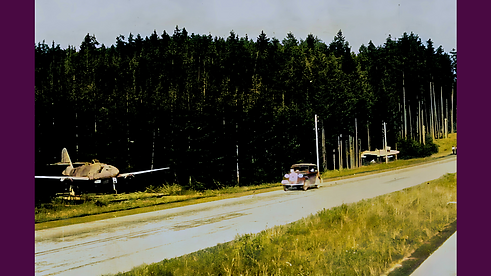
One of the earliest instances is the Reichsautobahn in Germany, constructed between 1933 and 1941.
As airbases were constantly attacked, sections of this highway were repurposed as emergency landing strips. Later in the war, these roads were even used for test flights of aircraft like the Messerschmitt Me 262 after bombing raids disrupted regular airfields.


U.S. Interstate System’s Military Role (1939-1944)
In the same decade, the U.S. Interstate System was conceptualized in the 1939 Bureau of Public Roads report "Toll Roads and Free Roads," and officially designated in the Federal-Aid Highway Act of 1944.
While primarily for civilian use, this infrastructure laid the groundwork for future military applications, particularly during the Cold War, as the system could support military mobilization and even aircraft operations if necessary.
Sweden’s Bas 60 and Bas 90 Systems (1950s-1980s)
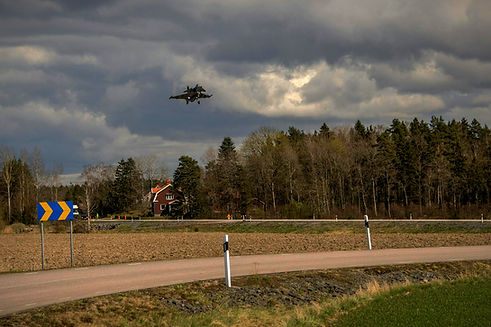
Sweden developed an extensive road runway system starting in the late 1950s under the Bas 60 system, designed to disperse air operations in the event of an airbase attack.
By the 1970s and 1980s, this evolved into the Bas 90 system, which featured shorter backup runways near airbases.
Aircraft like the Saab Viggen and JAS 39 Gripen were built with STOL (Short Takeoff and Landing) capabilities, allowing them to operate from these shorter strips, ensuring operational flexibility during conflicts.


Cold War Modifications: German Autobahn and NATO Drills (1984)
During the Cold War, the use of highways for air traffic resurfaced in Germany.
Highways were modified for emergency military landings on both sides of the Iron Curtain.
In 1984, NATO tested its aircraft on the Autobahn near Ahlhorn, where F-15 Eagles, F-16 Fighting Falcons, A-10 Thunderbolt IIs, and C-130 Hercules were involved in three weeks of drills.
These exercises ensured that pilots could land on highway strips if Soviet attacks destroyed NATO airstrips.
In South Korea, a C-123K Provider utilized a highway strip during the Team Spirit ‘89 exercise, highlighting the enduring military utility of these road-based airstrips worldwide.
Finnish Road Bases and Recent Exercises (1939-2023)
Finland has maintained road bases since 1939, notably using frozen lakes as airstrips during the Winter War to avoid Soviet air raids.
Throughout the Cold War, Finland continued developing secondary airfields, including road bases. As of 2017, all Finnish aircraft can operate from these strips.
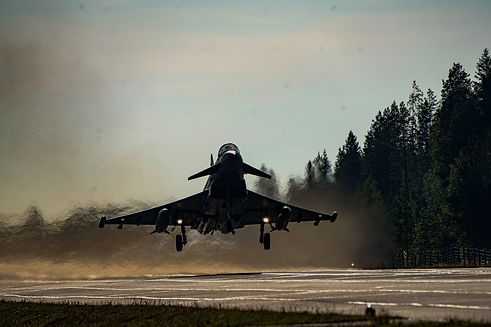
In 2016, Finland's Baana 16 exercise showcased its ability to deploy F/A-18C Hornets and other aircraft from highways, with participation from Sweden and Norway in subsequent exercises, including F-35 fighters in 2023.

Global Highway Strips: Widespread Use in Military Operations
Other nations have also maintained road runways for military purposes, including Poland, Singapore, Switzerland and Taiwan.
These countries can rapidly convert sections of highways into airstrips to maintain air operations even if military bases are incapacitated.
Australia, uniquely, does not use its highways for military purposes.