The New Axis of the Indo-Pacific: A 14-Year Odyssey Towards Trilateral Air Dominance
Sept 1, 2024 Rikeza Editorial Focus


Air Marshal Stephen Chappell, General Hiroaki Uchikura and General Kevin Schneider shake hands after signing a Memorandum of Intent during Exercise Pitch Black 2024 in Darwin. Photo: Leading Aircraftman Ryan Howell

A New Era of Indo-Pacific Defense
In a move reminiscent of the Allied forces' unity during World War II, the Japan Air Self-Defense Force (JASDF), Royal Australian Air Force (RAAF), and US Pacific Air Forces (PACAF) signed a historic Memorandum of Intent (MOI) on July 31, 2024.
This agreement marks a significant milestone in the development of trilateral air cooperation between Australia, Japan, and the US, as they collaborate to address the rapidly changing security environment in the Indo-Pacific region.
The MOI, 14 years in the making, aims to enhance the collective security of the three nations by sharing recognition, expertise, and resources. The agreement will facilitate joint planning, coordination, and execution of activities, ensuring a unified response to emerging threats.

A Cold War Redux? Parallels to NATO and the Warsaw Pact
The significance of this MOI can be likened to the formation of NATO in 1949, a collective defense against the Soviet Union.
Just as NATO served as a bulwark against communism, this new trilateral pact aims to secure the Indo-Pacific against the possibility of Chinese expansionism, especially in light of tensions surrounding Taiwan.
The comparison with the Cold War era’s alliances highlights the scale and seriousness of this agreement, suggesting a renewed era of great power competition.

Secretary Dean Acheson signing of the North Atlantic Treaty 1949. NATO archives

The USS Boxer (LHD 4) conducted a replenishment-at-sea with the Royal New Zealand Navy's HMNZS Aotearoa (A 11) in the Pacific Ocean on August 24, 2024, as part of routine operations in the U.S. 7th Fleet area of operations

Sailors disembarked a CMV-22B Osprey on the flight deck of the USS Carl Vinson (CVN 70) while underway in the U.S. 3rd Fleet area of operations in the Pacific Ocean on August 10, 2024.
(U.S. Navy Photo by Seaman Kenneth Ostas)
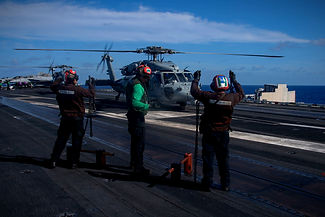
Sailors show cleared chocks and chains to pilots in an MH-60S Sea Hawk helicopter, assigned to Helicopter Sea Combat Squadron (HSC) 14, on the flight deck of the Nimitz-class aircraft carrier USS Abraham Lincoln (CVN 72).(U.S. Navy photo by Specialist Seaman Nathaly Cruz)
What’s Next?
From Words to Action
The MOI is just the beginning, it is a blueprint for a new era of trilateral military cooperation in the Indo-Pacific.
With specific lines of effort identified for 2025 and 2026, the MOI is set to operationalize this cooperation, enhancing readiness for scenarios that could range from deterrence to full-scale conflict.
The urgency of this cooperation highlights the precariousness of the current security environment, where the stakes are nothing less than the future stability of the Indo-Pacific.
If successful, this pact could set a precedent for even broader alliances, potentially involving other regional powers like South Korea and India, further tipping the balance against any potential aggressors.
The MOI isn’t just a piece of paper; it’s a signal to allies, adversaries, and the world that the Indo-Pacific is prepared for whatever may come.